• zoom

1911 – 2011

The New Orleans Museum of Art, the city’s oldest fine arts institution, has a magnificent permanent collection of almost 40,000 objects. The collection, noted for its extraordinary strengths in French and American art, photography, glass, and African and Japanese works, continues to grow. The five-acre Sydney and Walda Besthoff Sculpture Garden at NOMA is one of the most important sculpture installations in the United States, with over 60 sculptures situated on a beautifully landscaped site amongst meandering footpaths, reflecting lagoons, Spanish moss-laden 200-year-old live oaks, mature pines, magnolias, camellias, and pedestrian bridges.

NOMA continues to exhibit, interpret and preserve works of art from ancient to modern times. Paintings, drawings and prints, and decorative arts survey the development of Western Civilization from the pre-Christian era to the present. Reflecting its rich historic and cultural heritage in New Orleans, NOMA has formed a comprehensive survey of French art.

Among NOMA’s treasures is a group of works by the French Impressionist Edgar Degas who visited maternal relatives in New Orleans in the 1870s and painted just 20 blocks from NOMA. NOMA’s collection of works by masters of the School of Paris includes paintings and sculptures by Picasso, Braque, Dufy and Miro, among others.

NOMA has developed a unique Arts of the Americas collection, surveying the cultural heritage of North, Central and South America from the pre-Columbian period through the Spanish Colonial era. This collection is especially rich in objects from the great Mayan culture of Mexico and Central America, and in painting and sculpture from Cuzco, the fabulous Spanish capital of Peru. An important part of the Museum’s display of American art is a suite of period rooms featuring 18th and 19th century furniture and decorative arts

As it has for a century, NOMA continues to be a gathering place for all those seeking to share the beauty of this extraordinary collection or world art and learn from it. NOMA engages, educates and enriches the diverse populations within, and drawn to, the New Orleans area.
Mission Statement, Vision, & Values

MISSION: The mission of the New Orleans Museum of Art is to inspire the love of art; to collect, preserve, exhibit and present excellence in the visual arts; to educate, challenge and engage a diverse public.

VISION: The guiding vision of the New Orleans Museum of Art is to advance its position as a premier national visual arts Museum vital to the cultural and educational life of our city, state and region.

NOMA’S CORE VALUES
What do we believe in:

  • Quality. We consistently strive for excellence in all that we do. Quality in art is our fundamental objective.
  • Community. We endeavor to reach the largest and most diverse audience to enjoy and appreciate the benefits and treasures of the Museum.
  • Integrity. We adhere to the highest ethical standards in all Museum policies and practices for the board, staff and volunteers.
  • Stewardship. We professionally maintain the preservation, conservation, exhibition, scholarship and accessibility of the Collection.
  • Diversity. We are committed to serving a diverse public through innovation, enrichment and inspiration for people of all ethnic and cultural backgrounds.
  • Education. We seek to promote the visual arts through innovative educational programs and learning experiences to ensure broad participation from both traditional and new audiences.
  • Stability. We maintain economic stability through responsible financial planning and management, allowing NOMA to grow and accomplish its vision and mission for the future.
  • Creativity. We celebrate creativity in all cultures and from all periods. We continuously set high standards through openness to new ideas from the community, staff and supporters.
  • Collaboration. We recognize the importance of collaboration with other cultural, academic, scientific and professional communities to expand our reach, leverage our resources and diversify our audience.

History of the New Orleans Museum of Art

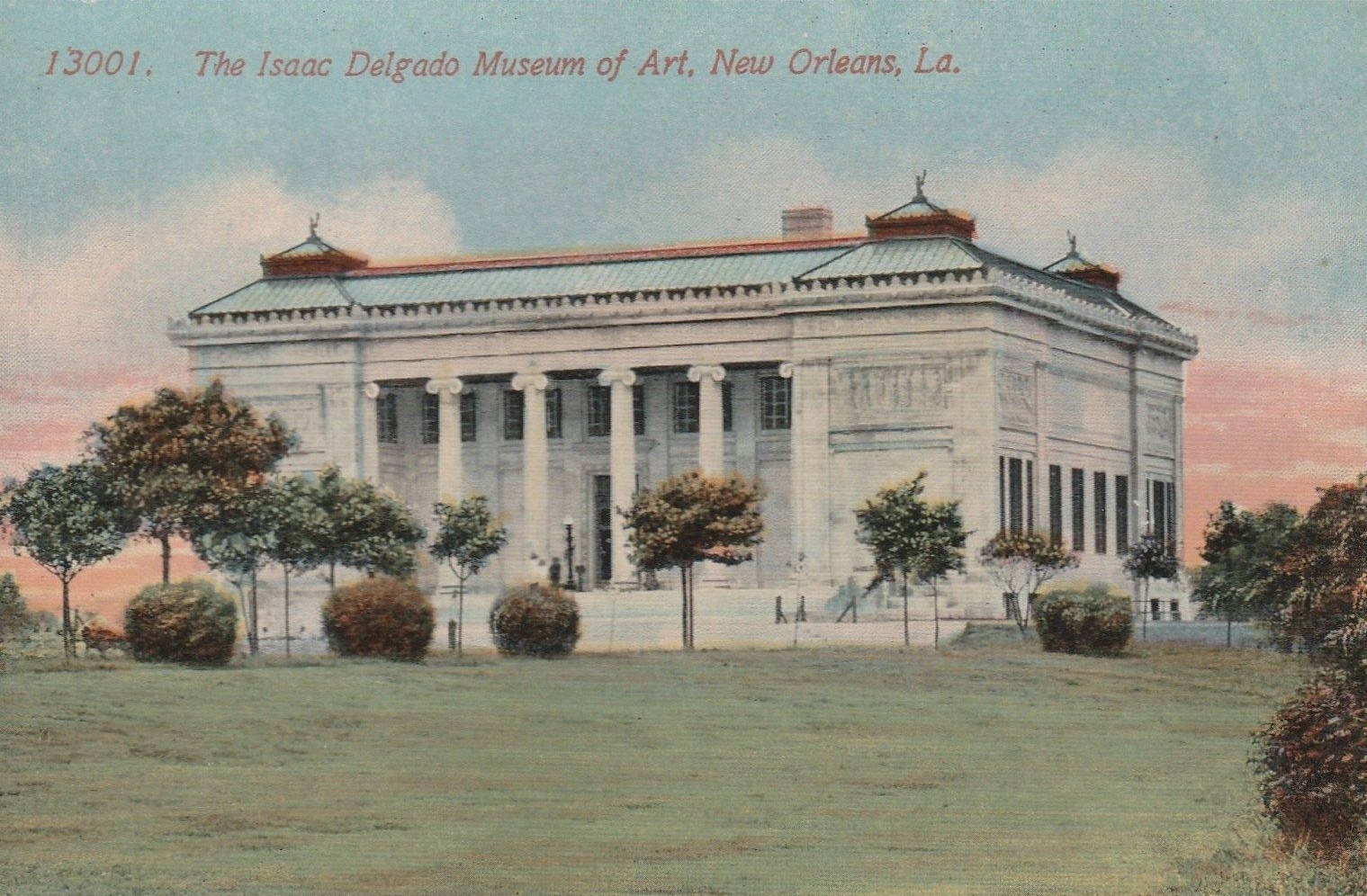
The institution now known as the New Orleans Museum of art began in 1910 when local businessman Isaac Delgado offered $150,000 to the City Park Commission for the purpose of creating a “temple of art for rich and poor alike.” One hundred years later, Delgado’s temple has become the premier art museum in the Gulf South and ranks in the top 100 art museums nationally.

Delgado’s selfless act remains shrouded in mystery. A Jamaican immigrant who became a millionaire sugar broker in New Orleans, he was not as a patron of the arts prior to his donation. Speculation remains that the childless Delgado offered to build the museum because he worried about the fate of the art collection amassed by his late but beloved aunt, Virginia McRae Delgado. Indeed, many of her collected treasures were displayed in the museum for years. But when asked about the donation, Delgado merely replied, “The gift speaks for itself and further than that I have no inclination to say anything.”

For all his desire, Delgado had no land for a museum. He approached the governing body of City Park, a 2,000-acre tract open to the New Orleans public. An agreement was made, and the Isaac Delgado Museum of Art opened in 1911.

The neoclassical building was designed by Chicago architect Samuel Marx, selected in a national competition. The setting was at the end of a tree-lined avenue surrounded by lagoons and majestic oaks. The young architect planned a building “inspired by the Greek, but sufficiently modified to give a subtropical appearance.”

Delgado, unfortunately, was too ill to attend the December, 16 1911, opening of the Isaac Delgado Museum of Art. But how proud he must have been when on December 10, 1911, the city newspaper Times Democrat declared “Delgado Museum Superb: The City’s Splendid Possession.”

The generous gifts of art from the people of New Orleans, as well as museum purchases made possible through financial gifts, made it apparent during the following years that the museum building would have to grow with its collection. An expansion that tripled the size of the Delgado Museum opened in 1971 with three new additions: the Wisner Education Wing, the Stern Auditorium and the City Wing, containing galleries for the permanent collection and special exhibitions. In recognition of support from the city and its citizens, the Trustees voted to change the institution’s name to the New Orleans Museum of Art (NOMA).

The increased size of the facility allowed NOMA, for the first time, to host such major international exhibitions as The Treasures of Tutankhamun (1977-78), The Search for Alexander the Great (1982) and The Art of the Muppets (1981). The 1971 expansion resulted in further generous donations and greater regional importance.

Within decades, NOMA was ready to grow again. Through a group of donors joining the City of New Orleans and the State of Louisiana, nearly $23 million was raised for expanding the museum. New space totaling 55,000 square feet was constructed, and the original 1911 Beaux-Art Delgado building and its 1971 additions were renovated to provide a state-of-the-art facility with a total of 130,850 square feet.

Today NOMA visitors will find Isaac Delgado’s dream thriving, with galleries to house its outstanding permanent collection, which contains nearly 40,000 works. There are three special areas within the 46 galleries at NOMA: the Lupin Foundation Center for Decorative Arts, a suite of galleries dedicated to NOMA’s extensive collection of glass, ceramic and silver; galleries dedicated to the development of Louisiana art during the past 200 years, from colonial portraiture to contemporary art; and galleries for NOMA’s outstanding African collection. The museum also has three galleries for traveling exhibitions. Two other additions are the Museum Shop and Café NOMA by Ralph Brennan.

The 5-acre Sydney and Walda Besthoff Sculpture Garden opened November 2003 and now includes over 60 sculptures. On March 20, 2010, the Garden reopened after a multi-million dollar renovation. It is now open seven days a week and is always free and open to the public.

A century later, the New Orleans Museum of Art and now the Sydney and Walda Besthoff Sculpture Garden remain “The City’s Splendid Possession.”

1910
Isaac Delgado gives $150,000 to the City Park Improvements Association for the erection of an art museum for the city of New Orleans to be located on the land in City Park. The prize for the architectural design of the museum is awarded to Samuel A. Marx of Chicago.

1911
The cornerstone dedication ceremony takes place at the museum on March 22. The Isaac Delgado Museum of Art opens to the public at 2 pm. December 16, with the opening ceremony attended by Mayor Martin Behrman and three thousand others.

1931
A first gift from Samuel H. Kress – Madonna and Child, by Giovani de Biondo – begins a long relationship between the museum and Samuel H. Kress Foundation.

The museum is almost forced to close because of budget cuts by the city of New Orleans. An uproar in the city’s newspaper forces the city to reinstate the funds.

1940
The show Picasso: Forty Years of His Art, organized by the Museum of Modern Art, includes Guernica.

1953
An exhibit of masterpieces, French Painting Through Five Centuries, 1400-1900, from the Louvre, is held. It has been organized to celebrate the 150th anniversary of the Louisiana Purchase. Attendance for the year 1953 is a record 104,000.

1966
First annual Odyssey Ball premieres exhibition Odyssey of an Art Collector: The Frederick Stafford Collection.

1971
The board of trustees changes the name of the institution to New Orleans Museum of Art.

1972
The museum is accredited by the American Association of Museums, Washington, D.C.

1973
E. John Bullard becomes the fifth director of the museum. He begins NOMA’s photography collection.

1977
Treasures of Tutankhamun opens at the Museum and is seen by 900,000 persons in four months.

1985
The museum purchases Portrait of Marie Antoinette, by Elisabeth-Louise Vig’e-Lebrun, for $500,000 in observance of NOMA’s 75th anniversary.

1986
The museum embarks on a year-long celebration of its Diamond Jubilee. NOMA plans an expansion program that will almost double the size of the building.

1988
A fundraiser that was to become an annual favorite, Art in Bloom blossoms for the first time.

1990
NOMA presents a five-month exhibition of the sculpture of Auguste Rodin from the Gerald Cantor Collections, the largest and most comprehensive private assemblage in the world.

1991
Ground-breaking ceremonies herald the commencement of construction on the museum’s extension, with $20 million raised to achieve it.

1993
Music, entertainment, and family fun celebrate the opening of the $23 million expansion and renovation project. The scale of the project, coupled with increased art acquisitions, place NOMA into the top 25 percent of the nation’s largest and most important fine art museums.

1996
Long the home to the Faberge collection of the Matilda Geddings Gray Foundation, NOMA hosts a major national Faberge exhibition tour Faberge in America.

2000
The board of Trustees authorizes a multi-million dollar campaign to fund the construction of the Besthoff Sculpture Garden and endow its operation.

2003
To commemorate the bicentennial of the Louisiana Purchase, the museum organizes one of its most ambitious presentations ever, Jefferson’s America and Napoleon’s France with more than 260 objects from numerous institutions in the USA and Europe.

The donation by the Besthoff family of more than forty major sculptures by modern masters and the creation of the free Besthoff Sculpture Garden, now open to the public, is a magnificent benefit to NOMA and the people of New Orleans.

2005
Hurricane Katrina closes NOMA, fortunately with no damage to the collection although $6 million in damage to the building and the Besthoff Sculpture Garden is sustained; more than 80 members of staff are laid off; a skeleton staff of sixteen remains, working from borrowed quarters in Baton Rouge while the museum and New Orleans recover.

2006
The museum, closed for seven months, re-opens with four exhibitions. Important works from the permanent collection travel the country in four exhibitions to raise money for hurricane recovery: Impressionists and Modern Masters from the New Orleans Museum of Art; Resonance from the Past: African Sculpture from the New Orleans Museum of Art; From the Big Easy to the Big Apple: Two Centuries of Art in Louisiana; The Odyssey Continues: Masterworks from the New Orleans Museum of Art and from Private New Orleans Collections.

2007
An exceptionally generous gift from the people of France, the exhibition Femme, Femme, Femme: Paintings of Women in French Society from Daumier to Picasso from the Museums of France brings 85 works of art assembled from 45 institutions to fulfill a promise of support made just two months after the disaster.

2009
The Walt Disney Studio generously underwrites major exhibition, Dreams Come True: Art of the Classic Fairy Tales from the Walt Disney Studio, presented exclusively at NOMA, the only U.S. venue for this exhibition.

2010
Closed for eight months for comprehensive restoration of damage done by Hurricane Katrina, the Besthoff Sculpture Garden re-opens with a ceremony of ribbon-cutting and re-dedication.

After nearly thirty-eight years of service, E. John Bullard retires as Director, becoming Director Emeritus and manager of the Centennial Celebration.

After a nation-wide search, Trustees select Susan Taylor as NOMA’s sixth Director.

2011
The museum celebrates its centennial year with exhibitions that highlight NOMA’s vast permanent collection and a 31-hour birthday party from December 16-17, which is free and open to the public.